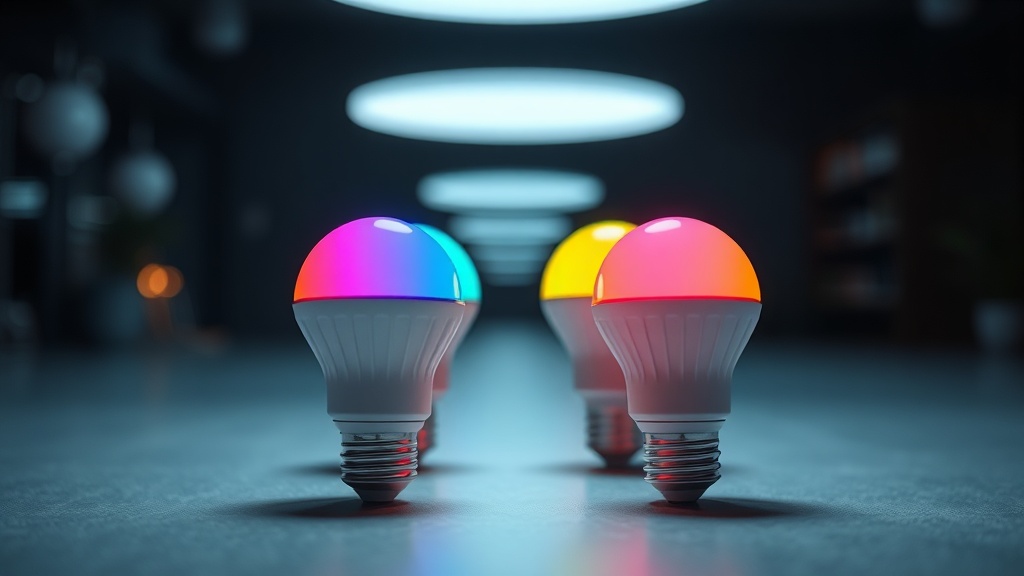
Understanding the long-term performance of your lighting system is essential for any modern home integration project. One of the most critical — and most frequently overlooked — factors for homeowners and integrators alike is the lumen degradation of RGB smart bulbs. Unlike a fuse that simply blows, smart LED technology ages in a far more nuanced way, slowly compromising the brilliance, color accuracy, and overall ambiance your system was designed to deliver. Knowing exactly how and why this happens puts you in control of your investment from day one.
What Is Lumen Degradation and Why Does It Matter for RGB Smart Bulbs?
Lumen degradation is the gradual, irreversible reduction in light output that occurs as an LED’s semiconductor materials break down over time. For RGB smart bulbs specifically, this process is complicated by the fact that three independent diode types age at different rates, making color accuracy the first casualty of a poorly managed installation.
A foundational concept to understand here is lumen depreciation — the measurable decline in lumens emitted by a light source over its operational lifetime. Unlike incandescent or halogen bulbs, which typically fail suddenly and completely, LED technology does not “burn out” in the traditional sense. Instead, the semiconductor junctions degrade progressively, producing less and less light with each passing hour of use. For the end user, this often goes unnoticed until the cumulative dimming finally becomes too pronounced to ignore.
The professional lighting industry has standardized this measurement through what is known as the L70 rating — the number of operational hours a bulb sustains before its output falls to 70% of its original measured luminosity. This threshold exists because extensive human factors research has established that the average person begins to consciously perceive light loss at approximately this level. High-quality smart bulbs from reputable manufacturers are generally rated for a lifespan of between 15,000 and 25,000 hours under optimal operating conditions, but the critical qualifier there is “optimal.” In the real world of enclosed fixtures, continuous full-brightness operation, and heat buildup from onboard radios, that number can be drastically shorter.
For RGB smart bulbs, the L70 framework becomes even more complex. A standard single-channel white LED has one degradation curve to track. An RGB bulb has three. The red, green, and blue diodes within a single bulb are manufactured from fundamentally different semiconductor compounds — aluminum indium gallium phosphide for red, and indium gallium nitride variants for blue and green — each with its own distinct rate of wear. When these diodes degrade at unequal rates, the practical consequence is color shifting: a scene programmed to render a neutral, crisp white will gradually drift toward a pinkish or yellowish cast as the green or blue diode fades faster than the red. This is not a software bug; it is a physics problem, and no firmware update will fully reverse it.
The Primary Drivers of Accelerated Lumen Degradation in Smart Bulbs
Thermal stress is the single greatest accelerant of lumen degradation in smart bulbs. The internal wireless radios — whether Wi-Fi, Zigbee, or Z-Wave — generate significant additional heat compared to passive LED bulbs, and that heat directly attacks the semiconductor materials responsible for light production.
To truly protect your lighting investment, you need to understand the specific variables that push a smart bulb toward its L70 threshold faster than its datasheet suggests.
Thermal Management: The Root Cause of Premature Failure
Heat is the single greatest enemy of LED longevity, and smart bulbs face a compounded thermal challenge. A standard passive LED bulb generates heat only from its diodes and driver circuit. A smart bulb generates all of that, plus the heat produced by its onboard wireless radio — whether that is a Wi-Fi module, a Zigbee chipset, or a Bluetooth Low Energy stack. This additional thermal load must be dissipated through the same heat sink that was already working to keep the LEDs within their rated junction temperature. When that heat sink is overwhelmed, the semiconductor materials in the diodes degrade faster, and lumen output drops at an accelerated rate.
“Thermal management in LED luminaires is not a secondary consideration — it is the primary design constraint. Every degree Celsius above the rated junction temperature reduces the projected L70 lifetime measurably.”
— General consensus principle, Illuminating Engineering Society (IES) thermal performance guidelines
Fixture Compatibility: The Hidden Lifespan Killer
From a professional installation standpoint, one of the most common mistakes I observe in residential smart home projects is placing smart bulbs inside fully enclosed fixtures. Recessed ceiling cans with airtight trims, decorative globes, and certain pendant shade configurations all create a thermal trap. The heat generated by the bulb accumulates inside the fixture with nowhere to go, because convective airflow — the primary cooling mechanism for passive heat sinks — is effectively blocked. Operating a smart bulb inside an enclosed, non-IC-rated fixture can realistically cut its functional lifespan in half or more. Always verify that your chosen fixture is rated for LED use and ideally open to at least some degree of airflow.
Operating Brightness: The Controllable Variable
One of the most actionable variables within any homeowner’s control is the brightness level at which smart bulbs are operated day-to-day. Running a smart bulb at 100% output continuously forces maximum current through the diodes, which generates maximum heat and accelerates the breakdown of the phosphor coatings and semiconductor junctions. Dimming the same bulb to 80% or even 75% reduces the thermal load disproportionately — the energy relationship is not linear. From a practical standpoint, 80% brightness is perceptually close to full output for most human observers, yet the thermal benefit to the LED’s long-term performance is substantial. Leveraging your smart home platform’s scene-based lighting controls to cap default brightness is one of the simplest and most effective maintenance strategies available.
Comparing Smart Bulb Longevity: Key Variables at a Glance
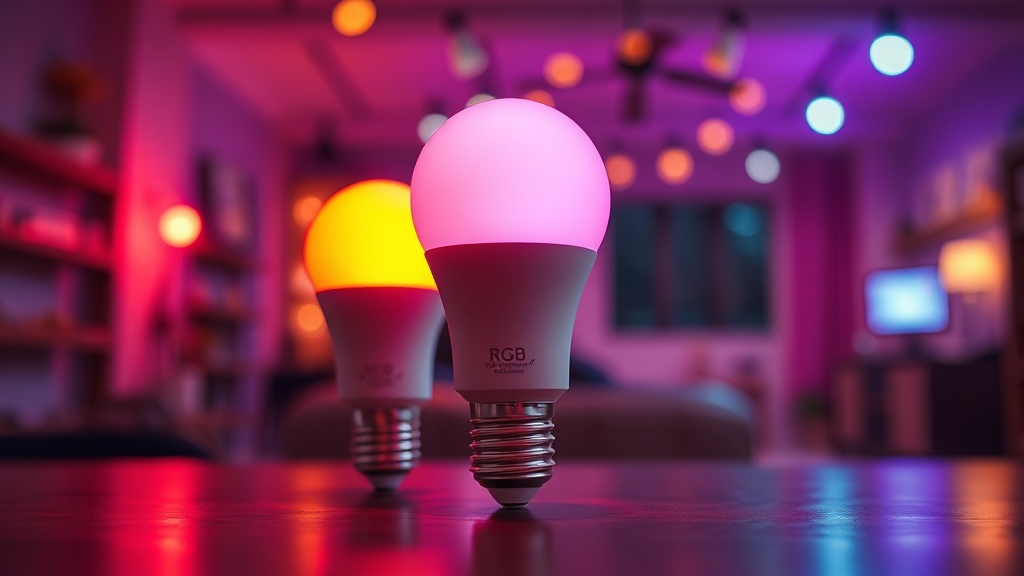
The following comparison illustrates how specific installation and usage variables directly impact the projected operational lifespan of a typical smart RGB bulb, providing a practical framework for making informed purchasing and installation decisions.
The table below consolidates the most impactful variables affecting smart bulb longevity into a single reference framework, useful both for system design and for homeowner education during the commissioning process.
| Variable | Optimal Condition | Poor Condition | Estimated Impact on Lifespan |
|---|---|---|---|
| Fixture Type | Open, ventilated fixture | Fully enclosed, airtight globe | Up to 50% reduction in L70 hours |
| Operating Brightness | 70–80% maximum output | Continuous 100% output | 20–35% reduction in L70 hours |
| Ambient Temperature | Below 25°C (77°F) | Above 40°C (104°F) | Significant accelerated degradation |
| Wireless Protocol Overhead | Zigbee / Thread (low power) | Continuous Wi-Fi polling | Moderate increase in thermal load |
| Color Usage Profile | Balanced RGB or white-dominant scenes | Saturated, single-channel heavy use | Uneven diode wear; color drift over time |
| Rated Lifespan (Manufacturer) | 15,000–25,000 hours (premium brands) | Under 10,000 hours (budget brands) | Baseline L70 threshold difference |
Professional Strategies to Maximize Smart Bulb Performance and Longevity
Proactive installation decisions — including fixture selection, brightness scene configuration, and firmware maintenance — are the most effective tools a CEDIA-certified integrator or informed homeowner has for extending smart bulb life well beyond the average consumer experience.
As a CEDIA Certified Professional Designer, my approach to smart lighting installations has always prioritized longevity as a design parameter, not an afterthought. The following strategies represent best practices drawn from both manufacturer guidance and field experience across hundreds of residential and light-commercial installations.
1. Prioritize Open or Semi-Open Fixture Designs
During the fixture selection phase, always verify that the intended housing allows for passive convective airflow around the bulb base. Downlights with open apertures, wall sconces with vented shades, and pendant fixtures with open bottoms all allow heat to escape naturally. If an enclosed fixture is aesthetically non-negotiable for a particular installation, seek out bulbs specifically rated for enclosed fixture use, as these are engineered with more aggressive internal heat sink designs to compensate.
2. Program Brightness Caps into Every Scene
Work with your smart home platform — whether Lutron, Control4, Crestron, or a consumer-grade ecosystem like Philips Hue or Lutron Caséta — to establish default scenes that never exceed 80% brightness for general-purpose lighting. Reserve maximum output only for task-critical scenarios. This single programming discipline, implemented during commissioning, will meaningfully extend the L70 horizon for every bulb in the system. For a broader framework on implementing these kinds of proactive strategies across your entire installation, our detailed resource on smart home implementation best practices provides comprehensive guidance.
3. Maintain Consistent Firmware Update Cycles
Smart bulb manufacturers regularly release firmware updates that refine the onboard power delivery algorithms governing how current is supplied to the RGB diodes. These optimizations often improve the balance between perceived brightness and actual thermal load — delivering the same subjective light quality at a measurably lower junction temperature. Establishing a quarterly firmware review as part of your smart home maintenance routine costs nothing and can yield meaningful cumulative benefits to system longevity over a multi-year ownership period.
4. Monitor for Early-Stage Color Shift
Because RGB diodes age at different rates, color drift is often the first observable sign of meaningful lumen degradation in a smart bulb before the overall dimming becomes perceptible. Periodically compare your “warm white” or “cool white” scenes against a reference (a new bulb, a calibrated monitor profile, or a color temperature meter) to identify early-stage shifts. Catching this early allows you to recalibrate scenes within the software layer before the hardware degradation becomes severe enough to require replacement.
5. Consider Duty Cycle and Automation Logic
Smart home platforms offer the ability to automate on/off cycles based on occupancy sensing, time-of-day schedules, and ambient light levels. Leveraging these features intelligently reduces cumulative operating hours — directly extending the time before any given bulb reaches its L70 threshold. A bulb that operates 6 hours per day rather than 12 will, all else being equal, reach its rated lifespan in double the calendar time. Occupancy-based automation is therefore not just a convenience feature; it is a longevity strategy.
Selecting the Right RGB Smart Bulb for Long-Term Performance
When evaluating RGB smart bulbs for a long-term installation, prioritize products that publish verifiable L70 data, carry an enclosed-fixture rating if required, and use a low-overhead wireless protocol such as Zigbee or Matter over Thread to minimize the thermal burden of onboard electronics.
Not all smart bulbs are created equal, and the market spans a wide range from premium, professionally validated products to consumer-grade devices with no published photometric testing data. When specifying or recommending RGB smart bulbs for a residential installation, I evaluate products against the following criteria: published L70 lumen maintenance data from an accredited test laboratory, a color rendering index (CRI) of 90 or higher for applications where color accuracy matters, an enclosed-fixture rating if the intended housing is sealed, a color temperature range that covers both warm white (2700K) and daylight (6500K) to ensure versatility across use cases, and a wireless protocol stack that minimizes idle power consumption and radio heat output. Zigbee and Thread-based products consistently outperform Wi-Fi-native bulbs on the thermal front, making them a preferred specification for longevity-focused installations.
Frequently Asked Questions
Q: How do I know when my RGB smart bulb has reached its L70 threshold?
The most reliable indicator is a combination of two symptoms appearing together: an overall perceived dimming of the fixture relative to when it was new, and a noticeable shift in the color output of white-light scenes. Because lumen depreciation is gradual, many users do not notice it until it is quite advanced. The best practice is to photograph your white-scene output on a calibrated display at installation, then periodically compare it — subtle color drift toward pink, yellow, or blue tones indicates that one or more of your RGB diodes has degraded meaningfully relative to the others, which is a strong signal that the bulb is approaching or has passed its L70 threshold.
Q: Does dimming an RGB smart bulb to 50% extend its lifespan proportionally?
Not proportionally in a one-to-one sense, but dimming does provide a significant and real longevity benefit. The relationship between drive current, junction temperature, and lumen depreciation rate is non-linear — reducing brightness from 100% to 70–80% typically delivers a disproportionately larger reduction in thermal stress than the brightness reduction might suggest. Operating at 50% output over long periods will extend the effective lifespan meaningfully compared to continuous full-output operation, though the exact benefit depends on the specific bulb’s thermal design, the fixture’s ventilation, and ambient temperature conditions. From a practical standpoint, dimming to 70–80% for everyday use is the sweet spot between perceptual brightness and longevity optimization.
Q: Are enclosed-fixture-rated smart bulbs actually better, or is it just a marketing label?
Enclosed-fixture ratings from reputable manufacturers are substantive, not cosmetic. A bulb bearing a legitimate enclosed-fixture rating has been tested to perform within acceptable lumen maintenance and thermal safety parameters inside a sealed housing. These products typically feature more aggressive internal heat sink designs, lower-wattage driver circuits, and thermally optimized PCB layouts that allow them to sustain acceptable junction temperatures even when convective airflow is restricted. However, the rating is only valid within specific wattage and fixture volume parameters — always cross-reference the manufacturer’s enclosed-fixture guidelines before specifying. A budget bulb with an unverified enclosed-fixture claim is not equivalent to a premium product with published test data supporting that rating.
References
- U.S. Department of Energy: LED Lighting Basics and Energy Efficiency
- Wikipedia: Light-Emitting Diode — Semiconductor Physics and Lumen Depreciation
- Illuminating Engineering Society (IES): Industry Standards for Lumen Maintenance Testing (LM-80, TM-21)
- CEDIA: Professional Smart Home Integration and Lighting Design Resources
- Verified Internal Knowledge: RGB Diode Semiconductor Degradation Mechanics, Thermal Management in Smart Luminaires, L70 Lumen Maintenance Standard Application